
FAQ – Training Programs & Coaching


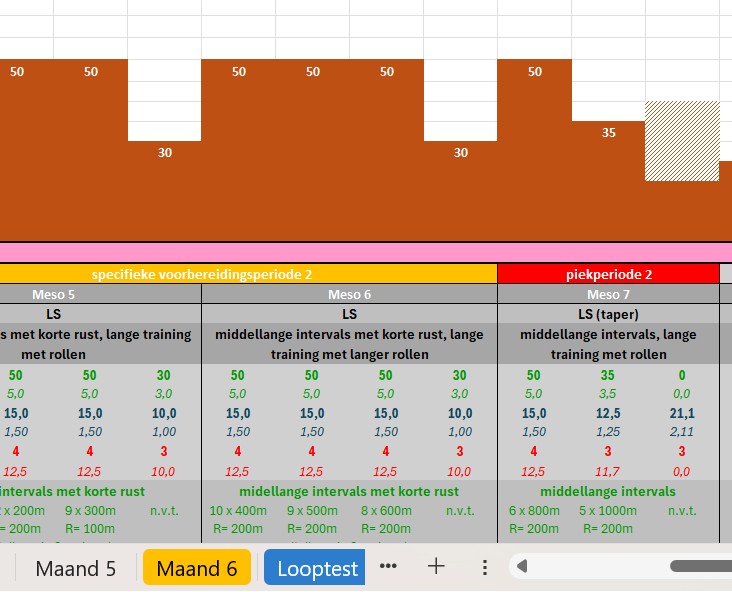


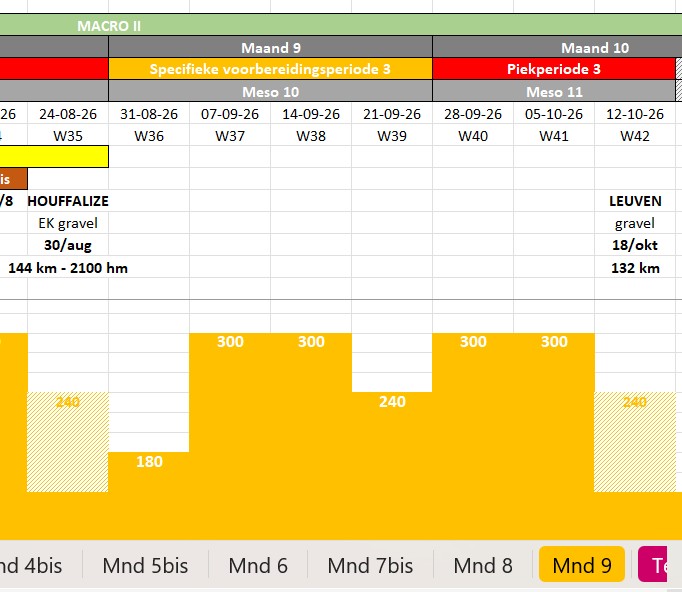

A training plan is a detailed form of training advice. The sessions are worked out in detail, and if desired also spread across the week, taking into account your possibilities and preferences.
I often (and preferably) speak of training proposals rather than training programs. The program is a guideline – nothing more, nothing less. I become suspicious if it is followed to the decimal point. It is ‘the spirit of the plan’ that counts: it is primarily about the underlying training principles (supercompensation, progression and specificity), and about the order of magnitude.
As a coach I always start from a broader plan, an ‘annual plan’ (whether or not a full year), which reflects ‘the bigger picture’ (sporting goals, holidays, periods with more or less training time, etc.), and which serves as the framework for developing the more detailed training plan. I work out such ‘detail plans’ per 4 weeks.

It’s about the ‘spirit’ of the training program, its underlying principles and the order of magnitude.
It’s not about short-term problem-fixing, but rather structural solutions.
Yes, apart from the format in which the plan is drawn up and communicated (email, paper, specific or less specific software programs, etc.), plans can be worked out in more or less detail (e.g. per week or day by day, e.g. only the core of the session or also with a worked-out warm-up and cool-down, etc.). You can also choose to have one plan (of 4 weeks) drawn up and then repeat it once or twice: this can be a simple and cheaper way to have a guideline for, for example, the winter period, where there is less need for build-up.
1) when you are working towards a concrete goal:
– e.g. completing the Antwerp 10 Miles, climbing Mont Ventoux by road bike, finishing an ironman in a personal best time, …
– if you have no concrete, time-bound, specific goal, a plan has little value in my opinion: a few general guidelines for structuring your week can often suffice.
2) when you want to gain more training insight and/or are ready to get a better grip on the ‘tricks of the trade’:
– you absolutely do not need to be a top athlete to ask for a ‘concrete guideline’
– a plan is, on the other hand, rarely useful — and rather ‘overkill’ — for a complete beginner: here too, a few general guidelines (regarding F.I.T.T. — frequency, intensity, time & type) usually suffice.
3) when you want to get the most out of your potential:
– potential on a physical level: to ‘peak’ as well as possible
– potential in terms of available time: to train as efficiently and effectively as possible.
It’s not about holding their hand; it’s about teaching them to stand on their own feet. A coach opens the door; you enter by yourself.
That is certainly possible and open for discussion!
At the same time, I assume you are contacting me because you do not want a ‘one-size-fits-all’ plan from the internet, not even an AI-generated one, but a fully personalised approach that takes your situation and ambitions into account as much as possible, and that can be adjusted if needed. In the pricing, interim adjustments and questions are always factored in to some extent.
That depends on the time I expect to invest in the coaching, which in turn depends on various factors:
1) with or without systematic follow-up
2) the sport discipline (e.g. drawing up plans for swimming and/or triathlon takes much more time than (purely) running or cycling)
3) the sporting goal (e.g. a classic request is a marathon, where a plan typically also covers only a short period of time)
4) what is and is not expected of me as a coach: everything is open for discussion.
Do not hesitate to contact me for a quote.
The trainer makes the athlete, and the athlete makes the trainer (Mon Vanden Eynde).
To a certain extent. As an exercise physiologist, I am well well-versed in nutrition immediately before, during and after exercise. Regarding regular daily nutrition, I recommend my colleagues, Annick Joos or Nina Pagan, dietitians.